Buying the truck and getting operating authority may be what makes an auto transport business possible, but neither one is the business model.
Before the first vehicle is loaded, a carrier already has several decisions to make beyond authority, insurance, and paperwork. Where will the freight come from? Which lanes make sense? How much deadhead can the operation absorb? How long can revenue sit in accounts receivable before cash gets tight? What happens when the truck needs an unexpected repair? Which software, load boards, payment methods, and operational processes will the business rely on?
These questions become especially important during the first year, when assumptions turn into actual operating numbers.
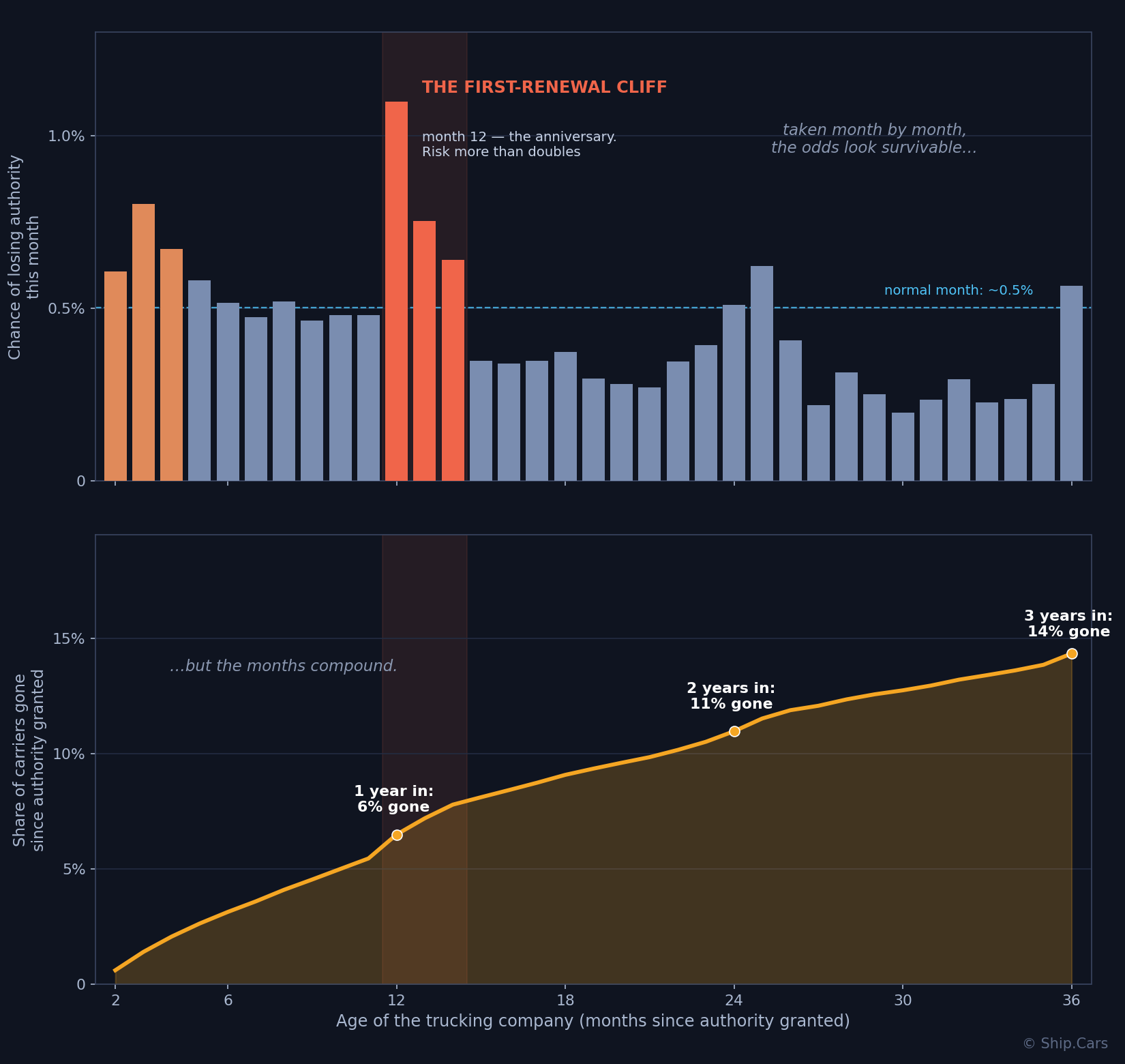
FMCSA data shows a clear increase in carrier authority revocation around the first anniversary. Among auto transport carriers first granted authority in 2018 or later, the monthly risk of a first involuntary revocation stays around 0.5% through much of the first year before rising to roughly 1.1% around month 12. By the end of year one, about 6% of carriers in the cohort had experienced a first revocation; that share rose to roughly 11% by the end of year two and 14% by the end of year three.
That does not mean 14% of those carriers permanently went out of business. Some later reinstate their authority. But the first-anniversary spike does point to a period when young carrier businesses are unusually vulnerable – and insurance sits very close to the center of it.
Why does carrier authority revocation rise around the first anniversary?
The analysis tracks a carrier’s first dated involuntary authority revocation, rather than voluntary closure or permanent business failure. In practice, these revocations are overwhelmingly associated with failure to maintain the insurance required to keep operating authority active.
Insurance and authority are also closely connected from the beginning. A carrier cannot simply obtain authority and worry about insurance later. For a new operation, the beginning of its authority and the beginning of its first insurance cycle typically begin at roughly the same stage of the business. A year later, the carrier is no longer approaching insurance as an operation with no history of its own.
At startup, the insurer has relatively little carrier-specific information to evaluate. By the first renewal cycle, there may now be a year of claims history, driver records, inspections, loss experience, securement practices, condition documentation, operating radius, and other evidence of how the business actually handles auto-hauling risk. One specialty trucking insurance source specifically points to clean MVRs, documented securement procedures, timestamped condition photos, and a clean loss run through the first renewal cycle as factors that can help an auto hauler control insurance costs over time.
The month-12 spike does not prove that insurance renewal alone causes every revocation. What it does show is that the timing of authority loss overlaps with a stage when a new carrier has accumulated something it did not have at startup: an actual operating record.
And that operating record is being created while the carrier is also finding out whether the economics of the business work.
Why does insurance matter so much during a carrier’s first year?
Auto-hauler insurance is not simply another recurring bill. It is both a condition of maintaining operating authority and a significant part of the cost structure of the business.
Auto hauling also creates insurance exposures that are different from those of general freight. One trailer can carry several customer vehicles with a combined value well into the six figures. Vehicles are repeatedly driven on and off equipment, secured, inspected, transported, and unloaded. The tractor and trailer themselves may be highly specialized, and shippers can impose insurance requirements beyond the federal minimum depending on the work being performed.
That means a prospective carrier needs to think about insurance before launch as part of the actual business model, not simply as paperwork required to activate authority. The relevant questions include what kind of vehicles the carrier plans to haul, what cargo limits are appropriate, what customers may require contractually, what operating radius is planned, and whether the insurance being budgeted for actually matches that operation.
Carriers with new authorities can also face materially higher insurance costs because insurers have less history on which to judge the risk. One specialty trucking insurance source places new-authority auto haulers among the harder commercial trucking risks to insure because they combine a specialized cargo exposure with little or no carrier-specific loss history.
But insurance costs do not sit independently from everything else happening during the year.
If the truck has spent months running lanes with excessive deadhead, waiting between loads, absorbing repairs, dealing with claims, or operating on thinner margins than originally projected, the next insurance bill or renewal may simply be where a broader financial problem becomes impossible to ignore.
The administrative reason an authority is revoked may be failure to maintain insurance. The business reason the carrier reached that point may have been developing for months.
What puts pressure on new carriers during year one?
One of the first assumptions that gets tested is load availability.
A newly authorized carrier may be able to create an account on a public load board, see available listings, contact the broker or shipper, and negotiate a rate. But access to the software – and even access to the listing itself – is not the same as being eligible to haul that load.
Increased fraud across transportation has made many brokers and shippers significantly more cautious about new authorities. In parts of the spot market, six months of active authority has become a common informal threshold before some companies will work with a carrier. It is not a universal rule, and different shippers use different vetting criteria, but a new carrier can find a suitable load, call on it, and still be declined at dispatch because the company has not been operating long enough.
If the business plan assumes that getting authority and insurance means the truck can immediately start booking from the load board, that may not be how the first few months actually play out. For a new carrier, the gap between being legally ready to operate and being accepted by shippers can make early revenue less predictable than expected.
Auto transport is also seasonal, so revenue can vary significantly throughout the year. A carrier’s August may look very different from December or January, which makes it even more important not to build a first-year plan around the assumption of steady monthly demand.
Then there is lane economics. A carrier can book a strong-paying outbound load and still produce a weak overall trip if the destination leaves the truck with poor return freight, significant deadhead, or several days of waiting. As directional auto transport rates show, the same market pair can produce very different economics depending on which direction the truck is moving. A posted rate tells the carrier what one load pays. It does not tell the carrier what the truck earns across all the miles and time required to complete the move and position for the next one.
The same applies to operating costs. Truck and trailer payments, fuel, insurance, maintenance, tires, tolls, compliance, software, taxes, factoring fees, repairs, downtime, and other expenses all have to be supported by the same revenue-producing equipment.
A carrier can also be profitable on paper and still run short of cash. Fuel may need to be purchased today while a completed load pays 15 or 30 days later. Insurance is due regardless of when the customer pays. A repair can happen while several invoices are still outstanding. Quick Pay or factoring can shorten that gap, but faster access to money usually comes with a fee that also affects margin.
Claims introduce another layer. Auto transport involves repeated vehicle handling, and not every damage event ultimately becomes an insurance claim. Some shipper or auction contracts allow smaller transit-damage amounts to be deducted or charged back directly to the carrier rather than routed through cargo insurance.
There is also a less formal industry practice: carriers sometimes choose to settle relatively small damage claims directly instead of submitting them to insurance. For a few hundred dollars of damage, paying out of pocket may be preferable to opening an insurance claim that becomes part of the carrier’s loss history ahead of renewal.
That can make sense for an isolated small claim – until several of those payments begin accumulating. The carrier is paying for the damage directly in cash while also continuing to carry and pay for insurance. What looks manageable one incident at a time can therefore become another operating cost that has to be absorbed by the same truck and the same revenue.
For a small carrier, all of these pressures are concentrated. One truck in the shop can mean most or all of the company’s revenue-producing capacity is unavailable. A deductible, an out-of-pocket damage payment, a slow-paying customer, or several days without suitable freight can therefore have a much larger effect than the same event would have on a large fleet.
None of these factors alone explains the first-anniversary spike.
Together, however, they show why the first year is more than a waiting period before renewal. It is the year in which the business discovers whether its original assumptions about freight, rates, operating costs, cash flow, claims, customers, and insurance actually hold up.
What should carriers plan before the first truck moves?
The authority-loss data should not be read as a prediction that a new carrier is likely to fail. Even during the month-12 spike, the large majority of carriers in the cohort do not experience an authority revocation during that month.
The more useful takeaway starts before authority is ever granted.
Opening an auto transport company requires planning for both the legal requirements and the business that will exist after those requirements are met. Insurance and authority may make the operation legal, but they do not answer where the loads will come from, whether the rates will support the equipment, or how the company will handle a month when revenue and expenses arrive on very different schedules.
Before launch, the plan should account for:
- Trip economics: what the truck earns across total miles, not only loaded miles, including realistic deadhead and waiting time
- Operating costs: fixed and variable expenses such as insurance, fuel, maintenance, equipment, tolls, software, taxes, and downtime.
- Cash reserves: enough room for repairs, slow payments, deductibles, out-of-pocket damage, and periods when suitable freight is harder to find.
- Early freight access: what work will realistically be available while the authority is still new and some shippers or brokers may not yet dispatch to the carrier.
- Insurance exposure: cargo limits, vehicle values, operating radius, customer requirements, documentation, securement practices, and the claims history being built before renewal.
By the time renewal approaches, the business should already know what that first year looks like on paper – rather than finding out when the insurer does.
The goal is not to predict every breakdown, claim, slow week, or difficult lane before opening the company. That would be impossible.
The goal is to make sure the business has enough room for those events to happen without one of them becoming the event that stops the truck.
Does carrier authority revocation mean the business has failed?
A first revocation is not the same thing as permanent business closure. Carriers can later reinstate their authority, and separate analysis shows that some do return after being inactive for a period of time. The cumulative figures in the authority analysis therefore should not be read as a permanent business-failure rate. The first-anniversary spike is better understood as a point of increased vulnerability.
By then, the carrier has spent a year making real decisions about lanes, freight, equipment, customers, claims, cash flow, and operating costs. At the same time, the insurer now has an actual year of operating history to evaluate rather than the assumptions available at startup. The timing matters because renewal arrives after many of the business’s original assumptions have already been tested in practice – and the cost of continuing into year two has to fit the business that actually emerged.
The first year ultimately tests whether the business around the truck is sustainable, not just whether the carrier can move cars.