Not long ago, using AI in software development often meant asking ChatGPT or Claude to generate a piece of code, explain a technical problem, or suggest a solution. These tools quickly became useful assistants for individual developers, but AI capabilities have since expanded considerably.
Today, AI can perform sequences of related tasks, communicate with other AI systems, interact with development tools, and support activities across the software development process. At Ship.Cars, we’re putting these capabilities to work through a more coordinated approach to AI-assisted development that extends from early product planning to implementation, testing, and maintenance.
For us, the opportunity is to improve how software gets built, reviewed, and maintained. By incorporating AI into these workflows, we’re giving our teams more ways to evaluate ideas, prepare development work, and improve the products that vehicle logistics businesses rely on.
Moving beyond individual AI assistants
As AI capabilities advance, so does the way development teams can use them. One of the most significant developments is agentic AI, which allows AI systems to carry out a series of related tasks toward a defined objective, interact with software tools, and produce results for further review or action.
Agentic AI also allows specialized agents to work together. One agent prepares a technical specification, another uses that information to generate code, and a testing agent verifies the resulting implementation. By exchanging information and passing work between agents, these systems can coordinate activities that would otherwise require separate manual steps.
At Ship.Cars, we’re incorporating these capabilities into a structured development process. Our AI agents communicate and exchange information as part of coordinated workflows, supporting activities across product discovery, technical evaluation, design, implementation, quality assurance, and maintenance. Each activity has a defined input, an expected output, and a person or team responsible for its review.

The outputs become part of the existing development workflow. An agent is able to prepare a ticket, generate a prototype, assist with technical documentation, propose code changes, or create test cases for QA. The resulting work is then available for the appropriate team to evaluate and approve.
Our approach is coordinated through an internal initiative focused on bringing these capabilities together. As we continue developing it, we’re evaluating where additional automation and closer coordination between different activities would be useful.
How Ship.Cars incorporates AI into development
Software development begins well before engineers start writing code. When a new feature is proposed, the Product team first needs to understand the problem, define the requirements, and determine whether the proposed solution is worth pursuing. Engineers then evaluate the technical approach, prepare the implementation, and verify that the changes work correctly within the existing software.
At Ship.Cars, AI agents assist with several parts of this process.
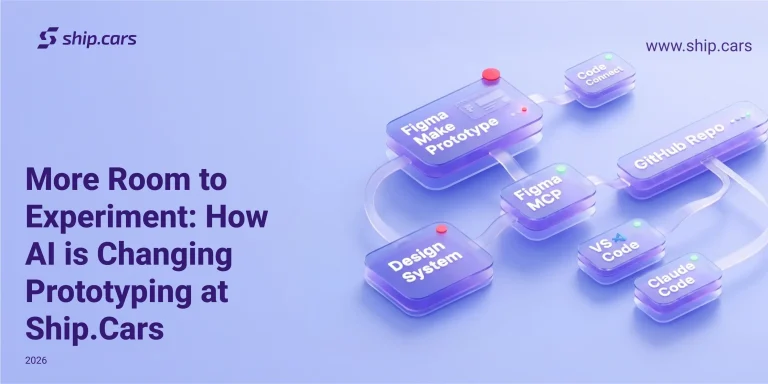
During early product planning, AI helps turn an initial problem or idea into a structured story ticket that the Product team reviews and validates. AI-generated prototypes also help our teams explore potential solutions and evaluate technical feasibility before committing to full development.
These prototypes serve two purposes. During discovery, they help Product assess whether an idea addresses the intended problem. During feasibility assessment, they help technical leads and architects evaluate the proposed approach and estimate the work involved. This allows teams to examine an idea more concretely before allocating significant engineering time.
Once a feature moves into design and implementation, AI assists with preparing designs, technical specifications, and proposed code changes. These specifications describe how different parts of the software should interact, giving developers a documented reference for implementation. AI-assisted development tools then support the backend and frontend work, with proposed changes submitted for developer review.
We’re also incorporating AI into testing. Agents generate test cases from stories and designs, making them available for QA review. Another AI-assisted workflow uses an automated browser testing framework to navigate the application and collect information needed to build UI (user interface) tests. AI also assists with preparing API tests, which check how different software components communicate with one another.
These activities help bring testing considerations into the process way earlier, while development work is still being planned and implemented.
AI assistance also extends to maintaining existing software. We’re integrating an agent into our internal systems to help investigate technical issues and prepare reports for Development, QA, and Support. This can reduce the time spent manually gathering and organizing information, allowing our teams to spend more time resolving issues and working on product improvements.
Together, these applications enable us to extend AI assistance across the work involved in building and supporting software, with structured outputs that teams can review and use as development progresses.
Keeping people responsible for the decisions
As AI agents become capable of handling more complex assignments and collaborating with one another, human oversight remains an essential part of our development process. Our agents can coordinate tasks and exchange information, while our teams remain responsible for evaluating the results and making decisions.
At Ship.Cars, every stage of development has a person or team responsible for reviewing and approving the work. From evaluating initial ideas to reviewing code and testing new functionality, our teams remain involved in the decisions that shape the final product. This structure allows us to expand the work AI agents perform while maintaining established engineering standards and clear accountability. Our teams determine what gets built, which approaches move forward, and when changes are ready for release.
What this approach means for our customers
For a dealership, broker, or carrier using Ship.Cars technology, the technical details behind software development are rarely the main concern. What matters is whether a feature addresses a real operational need, whether the software works reliably, and whether the platform continues to improve as business requirements evolve.
The way we develop software has a direct relationship with those expectations.
Take a proposed improvement to a vehicle dispatch workflow. Before development begins, we need to understand how customers currently handle the task, what they want to improve, where the difficulties occur, and how a proposed change might affect other parts of their workflow. AI-assisted discovery and prototyping help our teams explore possible solutions faster and see how they would work in practice.
Interactive prototypes are particularly useful here. Rather than relying entirely on static screenshots or workflow diagrams, we can create something people can click through and evaluate. In some projects, we also share these prototypes with customers, giving them an opportunity to identify missing steps, question how something works, and provide feedback before the actual feature is built.
Once development begins, the focus shifts toward making sure the feature works as intended. Even a relatively small change can affect other parts of the application, and AI-assisted testing helps our teams prepare more test scenarios, examine potential edge cases, and identify issues earlier. This supports a more efficient testing process and gives engineers and QA more opportunities to catch problems before a change reaches customers.
Documentation and maintenance contribute to the long-term reliability of the software as well. As applications grow and new functionality is introduced, development teams need to understand the technical decisions and dependencies behind earlier work. Keeping that information and context connected to the development process helps teams investigate issues and make future changes without having to reconstruct everything from scratch.
Our approach will continue to evolve as AI capabilities develop and we identify new opportunities to incorporate them into our workflows. At Ship.Cars, we’re focused on making those capabilities useful within the engineering practices that support our products, with the goal of delivering software that remains reliable, adaptable, and responsive to the needs of the auto transport industry.