Key takeaways
- Car hauler insurance underwriting looks beyond claims history. Driver experience, operating practices, maintenance, telematics and changes in the business can all factor into the evaluation.
- How a carrier manages risk matters alongside what has already happened. Underwriters may consider how safety data is used, how problems are addressed and whether risky patterns improve over time.
- Rapid growth can draw additional underwriting scrutiny. Adding trucks and drivers quickly can test whether existing processes and controls can keep pace.
- Operational changes can change the risk being insured. Longer routes, different freight and higher-value vehicles can alter a carrier’s exposure even when much of the business remains the same.
Insurance is one of the largest operating costs in auto transport, but carriers do not encounter a uniform insurance market.
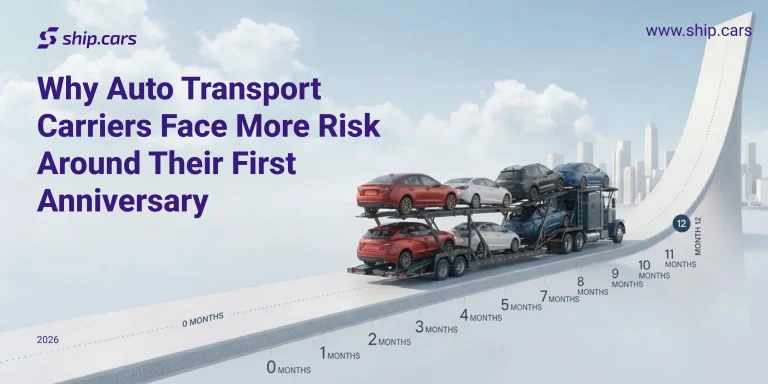
Our analysis of FMCSA liability filings shows substantial differences in the authority-age mix across major insurance groups. Some groups appear frequently among carriers in their first few years of operation, while others are concentrated much more heavily among established authorities.
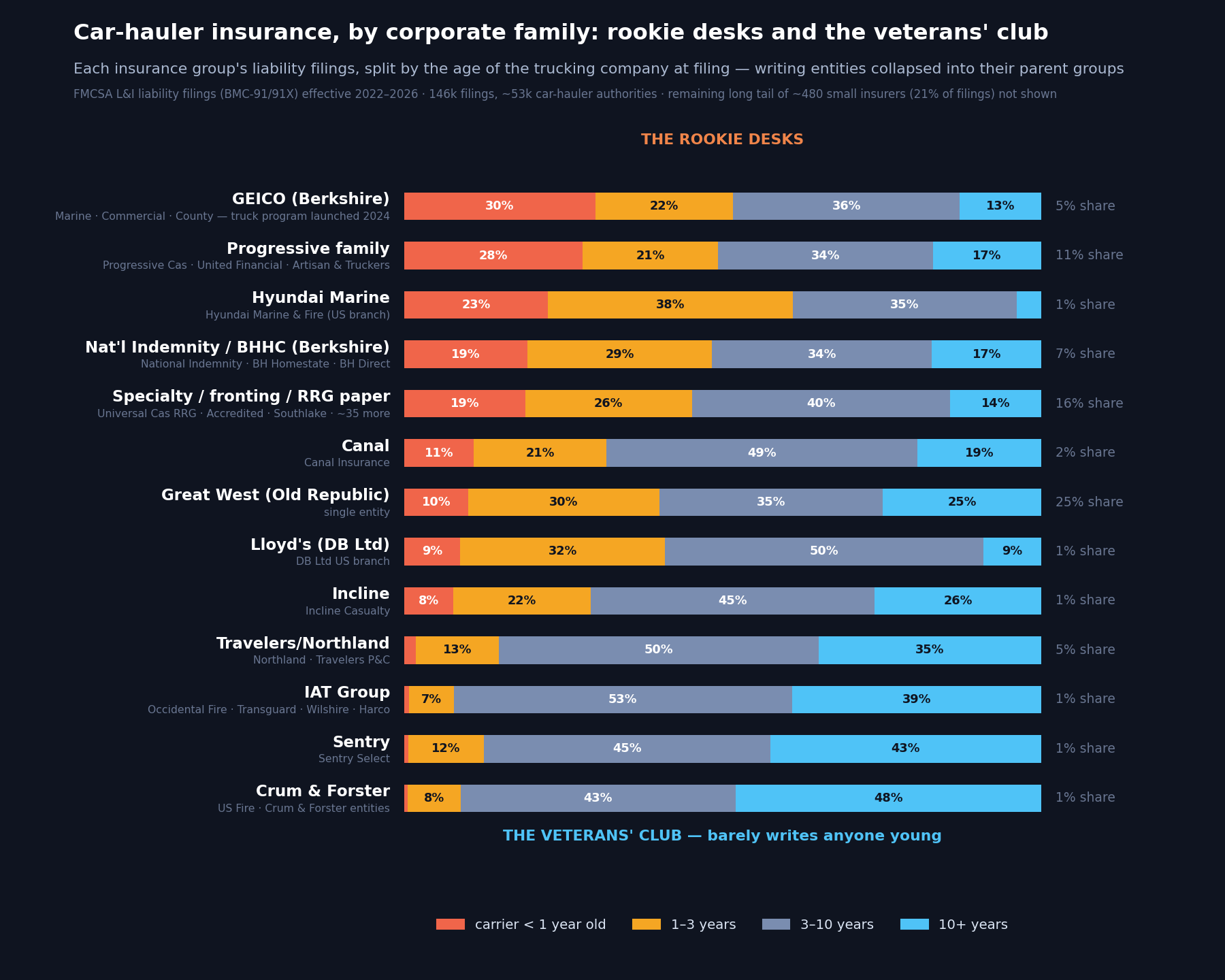
The chart shows those differences in the insured populations associated with each insurance group. It does not tell us what causes them. The patterns could reflect underwriting requirements, pricing, the types of operations different insurers write, broker relationships or other factors that cannot be determined from the filing data alone.
The filing data cannot answer those questions, but it gives us a reason to look more closely at car hauler insurance underwriting: what insurers evaluate when deciding whether to write or renew an operation, and how that information changes as a carrier builds operating history.
A new authority gives an underwriter relatively little operating history to evaluate. There is no established claims record and limited evidence of how the business performs in practice.
As the carrier builds history, that changes. By the carrier’s first renewal, the insurer has a year of actual operations to evaluate rather than relying primarily on the information available when the policy was first written.
What do underwriters look at when evaluating a carrier?
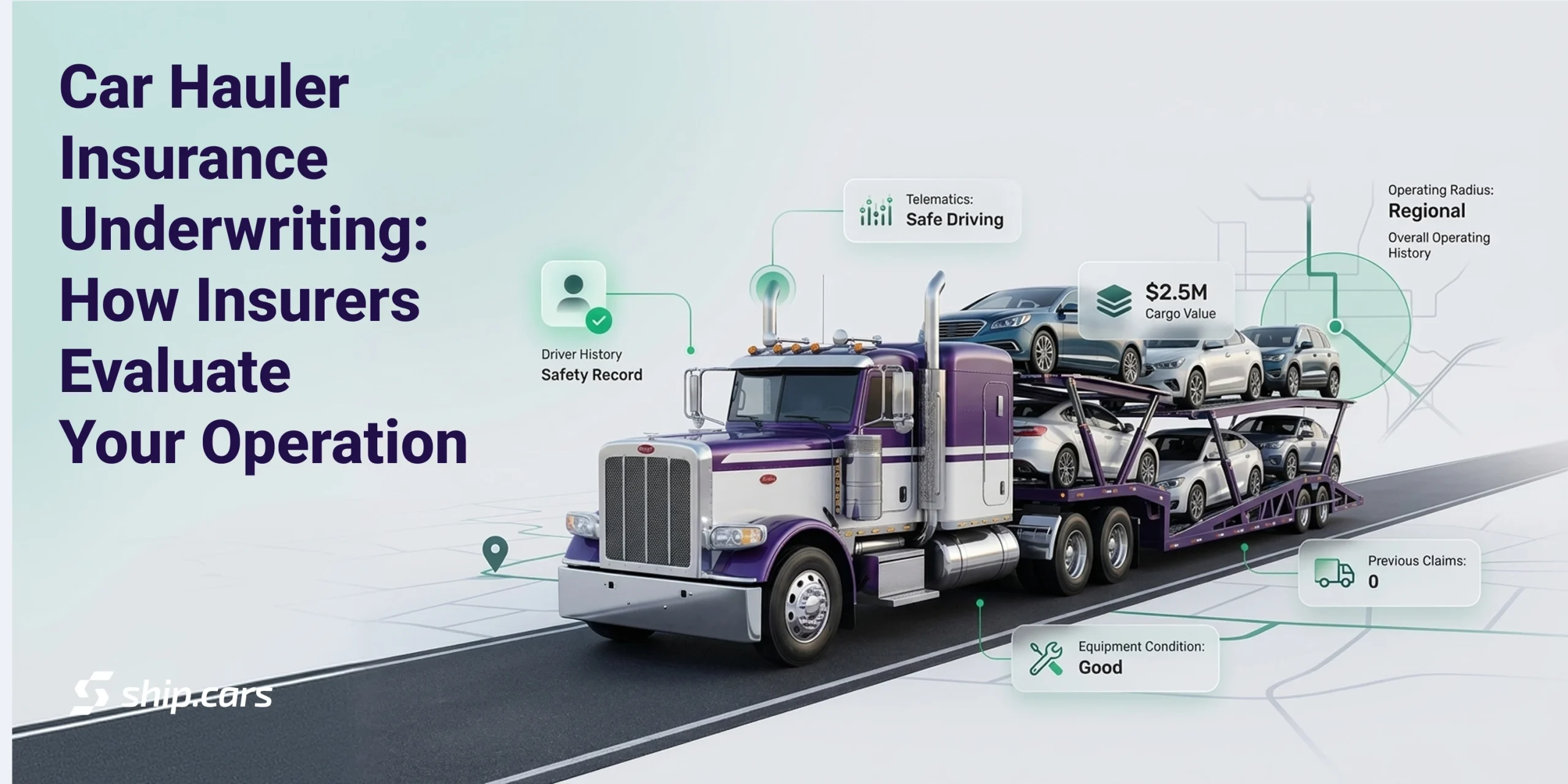
An underwriter is trying to understand the risk an insurance company would take on by covering a particular operation. There is no single number that provides that answer.
Two auto transport carriers may run similar equipment and request similar coverage while presenting very different risks. One may have operated for years with relatively few losses, while another has experienced several claims. Their drivers, routes, mileage, growth and day-to-day operating practices may also differ considerably.
Underwriting therefore involves evaluating several pieces of information together. Different insurers also have different underwriting appetites, meaning the same operation may not be viewed identically across the market.
How much does driver experience matter?
Driver history is one of the areas an underwriter can examine through motor vehicle records (MVRs), commercial driving experience, violations, accidents and previous equipment experience. But simply having commercial driving experience does not necessarily mean a driver has experience relevant to every type of trucking operation.
That distinction becomes particularly important in auto transport.
Driving a car hauler involves more than moving a commercial vehicle from one location to another. Drivers repeatedly load and unload customer vehicles, position them on specialized equipment, secure them and work within the height, weight and clearance limitations of the trailer. Underwriting preferences documented in the specialty insurance market specifically identify previous vehicle-hauling and similar equipment experience as factors insurers may consider.
A driver with years of general commercial experience may therefore still have relatively little experience with the work specific to transporting vehicles.
This becomes particularly relevant when a carrier hires. Adding another driver may allow the business to put another truck on the road, but that driver’s experience and driving record also become part of the operation presented to the insurer. For a smaller carrier, basic practices such as reviewing MVRs and setting clear experience requirements before hiring can help prevent introducing risks the business did not intend to take on.
What can loss runs tell an underwriter – and what they can’t?
A loss run is the claims record associated with an insured business over a defined period. It gives an underwriter evidence of the carrier’s actual loss history: how frequently claims have occurred, how severe they were, whether similar types of losses appear repeatedly and whether claims remain open.
What it cannot show on its own is everything that happened after those losses occurred.
Commercial auto underwriters interviewed by Truck News described looking beyond a fleet’s historical loss record at information such as driver scorecards, coaching records, telematics events and video. The objective is not necessarily to disregard previous claims, but to understand whether the conditions surrounding them have remained the same or changed over time.
Consider two carriers with similar historical losses. One continues operating without addressing the source of those losses. The other identifies recurring driver behavior, introduces coaching and later has data showing that the behavior improved. Their historical claims remain on the record, but an underwriter now has additional information with which to evaluate the two operations.
That is why a loss run is an important part of underwriting without necessarily being the complete picture.
Can telematics help a carrier at renewal?
Telematics can collect information such as vehicle location, speed, mileage, hard braking, rapid acceleration and other driving events. Cameras and other connected systems can provide additional context about what happens on the road.
For drivers – and sometimes carrier owners – this level of monitoring can understandably be a difficult sell. A system recording speed, harsh braking or driver behavior can easily feel like another mechanism for watching what happens inside the truck.
The same information, however, can also work in the carrier’s favor.
Video can help establish what happened when liability for an accident is disputed. In one example discussed by insurance professionals at the Samsara Beyond conference, a driver who had strongly opposed cameras changed his view after footage helped an adjuster dismiss a claim alleging that he had struck another vehicle.
For underwriting purposes, telematics can also provide information that a claims record alone cannot. It can show whether risky driving events are isolated or recurring and whether driver behavior changes after coaching or another intervention.
Simply installing a camera or collecting driving data does not automatically make an operation safer, nor does it guarantee a lower premium. Its usefulness depends partly on what happens with the information once it has been collected. If repeated speeding events appear, is the driver coached? If harsh braking occurs repeatedly on a particular route, does the carrier investigate the pattern? If an accident occurs, is the relevant footage preserved and made available quickly?
Over time, telematics can provide a record not only of driving events, but of how the business responds when those events indicate a problem.
What makes auto transport different from general freight?
Many of the underwriting considerations apply across commercial trucking, but hauling vehicles introduces additional exposure.
Unlike freight that remains sealed or otherwise largely untouched during transportation, vehicles are repeatedly handled. They are driven onto the trailer, positioned, secured, transported, unstrapped and driven off again. Pickup and delivery therefore introduce opportunities for damage that are specific to the way auto transport operates.
There is also the concentration of value on the trailer. One car carrier may transport several customer vehicles simultaneously, meaning a rollover, fire or other severe event can damage multiple vehicles in a single loss. Enclosed or specialized operations may carry substantially greater value depending on the vehicles being transported.
For that reason, insurers may consider the types and values of vehicles a carrier transports, how many are carried at once, the equipment used and how vehicles are secured and documented.
A clean highway driving record remains relevant, but it cannot describe all of the exposure involved in transporting vehicles. How the carrier handles customer property while it is in the carrier’s custody is part of the risk as well.
How can changes in the operation affect car hauler insurance underwriting?
The same truck can present different exposure depending on how it is being used. Operating radius, annual mileage, geography, route consistency and the type of work performed can all affect the conditions under which a carrier operates.
Growth can change several of those factors at once. A two-truck carrier expanding to six trucks, for example, may need to hire several drivers, maintain more equipment, cover additional routes and supervise a larger operation within a relatively short period. Insurance professionals specifically describe slow, controlled growth as preferable and note that rapidly expanding fleets, particularly newer operations adding trucks and drivers quickly, can face greater scrutiny from standard insurance markets.
The concern is not simply that six trucks represent more exposure than two. How the business manages that expansion matters as well. Hiring several drivers quickly means qualifying and supervising several new people at once, while additional equipment, routes and customers create more information for the business to manage. The question becomes whether the carrier’s existing processes have grown with the operation.
The work itself can change too. A carrier that previously transported mostly everyday passenger vehicles may begin working with customers moving classic, exotic or show cars. Even if much of the operation remains the same, the value concentrated on a load – and the potential cost of a handling or securement mistake – may be considerably different.
Operating radius provides another example. In one case discussed by insurance professionals, work beyond 250 miles represented only a small portion of a fleet’s revenue but generated a disproportionate share of its losses. Looking at claims alongside operational data exposed a pattern that the loss history alone did not explain, and the fleet ultimately reconsidered that work.
How important are maintenance records?
Preventive maintenance reduces the likelihood that mechanical problems turn into roadside failures or accidents. From an underwriting perspective, the records behind that maintenance can also provide evidence of how equipment is being managed.
Inspection records, repair histories, tire maintenance, brake service and scheduled maintenance can show what the carrier does before equipment fails rather than documenting only repairs made afterward.
The point is not to create paperwork solely for an insurance company. Maintenance records should exist because the maintenance itself is taking place. But at renewal, those records can give an underwriter something more concrete than an assurance that the trucks and trailers are well maintained.
What can smaller carriers realistically document?
Discussions about underwriting and fleet safety can quickly start sounding as though every carrier needs driver scorecards, a dedicated safety department, extensive written manuals and someone monitoring a telematics dashboard all day.
That is not realistic for a one- or two-truck auto transport business, nor does documentation necessarily have to operate at that scale.
A smaller carrier can document the practices it already needs to run consistently: how drivers are qualified, when MVRs are reviewed, how equipment is inspected and maintained, how vehicles are secured, what information is collected at pickup and delivery and what a driver is expected to do after an accident.
Those procedures do not need to become 50-page corporate manuals. Their value comes from being clear enough to follow and consistent enough to show how the business actually operates.
There is a meaningful difference between telling an underwriter that the company takes safety seriously and being able to show how a particular risk is managed. Across the underwriting sources examined for this article, that ability to demonstrate what actually happens inside the operation appears repeatedly in the information insurers examine.
What happens after something goes wrong?
Claims, violations and negative safety events become part of a carrier’s operating history and cannot simply be erased before renewal. What can change is the carrier’s response and the information available to explain what happened afterward.
Underwriters discussing commercial fleet risk increasingly describe looking at multiple data points and how they develop over time. That can give recent operational changes context that a historical loss record by itself cannot provide.
If one route repeatedly produces losses, does the carrier investigate why? If the same driver behavior continues appearing in telematics data, is anything done about it? If vehicle damage repeatedly occurs during loading or unloading, does the procedure change?
The answer does not make the original incident disappear. It can, however, show whether the conditions that contributed to it were identified and addressed.
A loss run will still show the claim. An MVR will still show the violation. What additional records can show is whether the carrier investigated the problem, changed a procedure, coached a driver or made another operational change in response. That gives the underwriter more information than the incident alone.